OEM vs ODM Custom Furniture Explained for Importers
Importers sourcing custom furniture from China encounter two primary manufacturing models: OEM and ODM. While often used interchangeably in casual conversation, they represent fundamentally different relationships regarding design ownership, development cost, speed to market, and brand differentiation. Choosing the wrong model wastes budget and delays product launches. This guide clarifies both approaches for B2B furniture buyers.
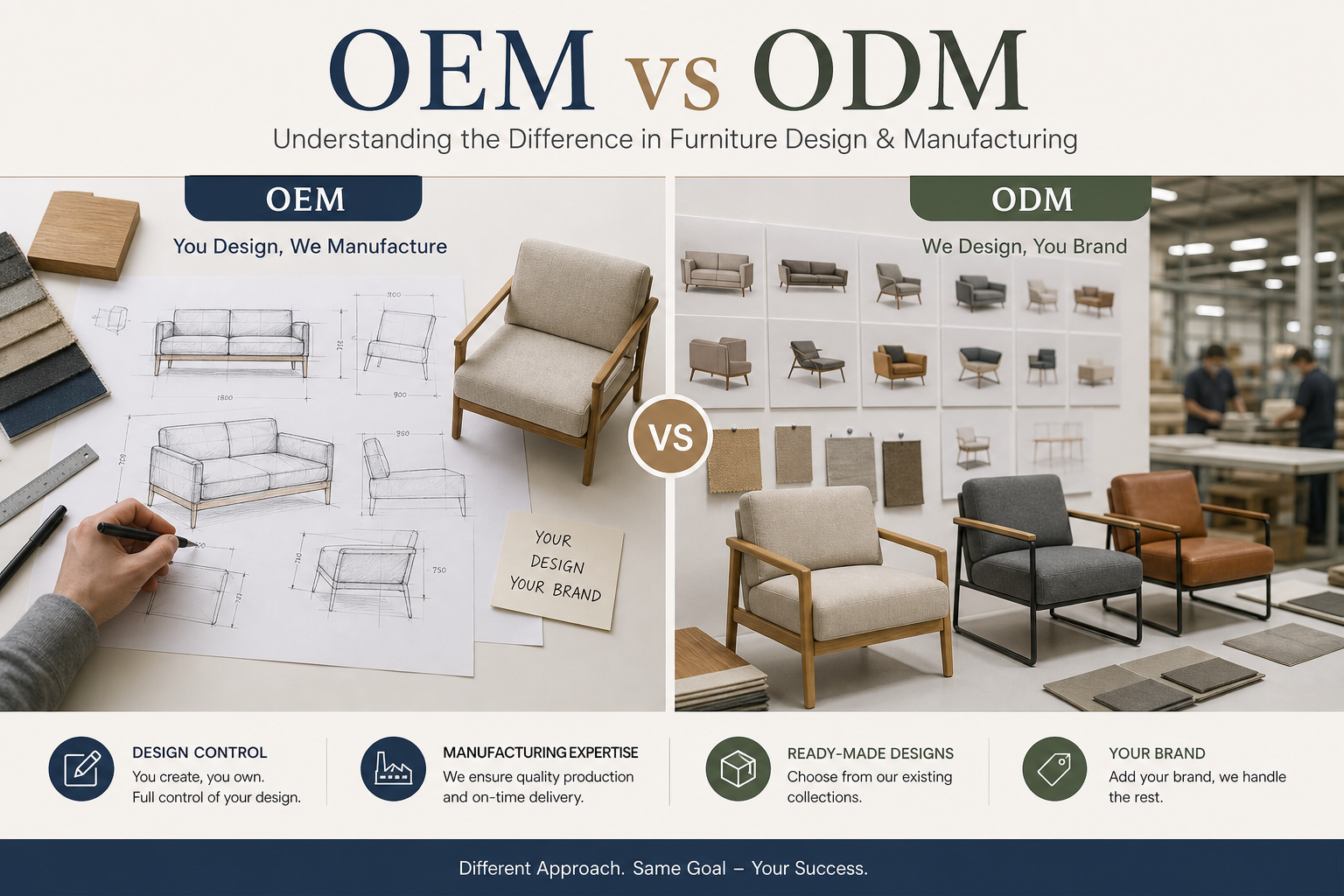
Definitions: OEM and ODM
OEM (Original Equipment Manufacturing): You provide the design, specifications, and branding. The factory manufactures to your drawings. You own the product identity and typically the design IP. Development time is longer because engineering starts from your brief.
ODM (Original Design Manufacturing): The factory provides existing designs you customize—finishes, dimensions, materials, packaging, and branding. You sell under your label but the base design originates from the factory catalog. Speed to market is faster; exclusivity is limited unless negotiated.
OEM vs ODM Comparison
| Factor | OEM | ODM | Best For |
|---|---|---|---|
| Design Source | Buyer provides | Factory catalog | Unique brand vs fast launch |
| Development Time | 8–16 weeks | 2–6 weeks | Planned seasons vs quick tests |
| Tooling / Sampling Cost | Higher | Lower | Exclusive lines vs budget entry |
| Exclusivity | Stronger (with contracts) | Weak unless market exclusivity deal | Premium positioning |
When to Choose OEM
Select OEM when brand differentiation is strategic—unique silhouettes, proprietary mechanisms, or retailer-mandated exclusive designs. OEM suits buyers with industrial design resources or licensed IP. Contract furniture, private-label premium lines, and hospitality custom projects commonly use OEM. Expect higher upfront sampling investment and longer lead times in exchange for market uniqueness.
OEM IP Protection
Sign NDAs and design ownership clauses before sharing CAD files. Specify that molds, jigs, and patterns paid by you remain your property. Register designs in target markets where applicable. Factories may reuse OEM-derived patterns for other clients if contracts are silent—close that gap explicitly.
When to Choose ODM
ODM works for importers testing new categories, filling price gaps quickly, or launching first container programs with limited design budget. You modify factory models with your finishes, fabrics, and cartons. Many successful Amazon and wholesale brands start ODM, then migrate bestsellers to OEM refinements once sales validate demand.
Hybrid Approaches
Experienced buyers combine models: ODM base frame with OEM custom upholstery program, or factory platform desk (ODM) with buyer-specified cable management and branding (OEM elements). Clarify which components are catalog versus custom in your PI to avoid scope disputes at inspection.
Exclusivity Negotiation for ODM
Factories may grant regional exclusivity on ODM designs if you commit to minimum annual volume—often 500–2000 units depending on SKU complexity. Get exclusivity in writing with enforcement terms. Without it, competitors may ship visually identical products through the same factory.
Cost Structure Differences
ODM unit pricing is often lower at equivalent MOQ because development is amortized across many buyers. OEM carries sampling fees ($500–5000+ per SKU), tooling, and engineering hours. Spread OEM development over projected 3-year volume to evaluate true unit economics—not first-order cost alone.
Quality and Perception Considerations
ODM does not mean low quality—many ODM designs meet export standards. The risk is homogeneity: your catalog may mirror competitors sourcing the same factory models. OEM lets you spec component upgrades (better gas lifts, thicker panels) even when starting from a similar category position.
Understanding OEM versus ODM helps importers match manufacturing strategy to business stage. Use ODM for speed and validation; invest in OEM where exclusivity and design leadership drive long-term margin and retailer relationships.
Decision Framework for New Product Launches
Ask three questions before choosing a model: Does the SKU need structural exclusivity? Is speed to market more critical than differentiation? Do you have design resources to manage OEM development? Honest answers route most first-time category entries through ODM, while hero products and retailer-mandated exclusives justify OEM investment.